
Many people think the PgMP exam is just a tougher version of the PMP. That belief mostly makes preparation harder than it needs to be. PgMP is not about managing tasks faster or memorizing formulas.
It’s about thinking like a program leader who connects strategy, governance, benefits, and stakeholders across multiple projects. Once you understand this shift, preparation becomes clearer and more focused.
In this article, we can discuss the month-by-month timeline that shows what PgMP exam prep realistically looks like, so you know exactly what to focus on and when.
PgMP Exam Format: What You Are Really Walking Into
Before diving into month-by-month preparation, it helps to know exactly what the PgMP exam looks like. Many candidates underestimate it, not because it’s tricky, but because it’s very different from knowledge-based exams.
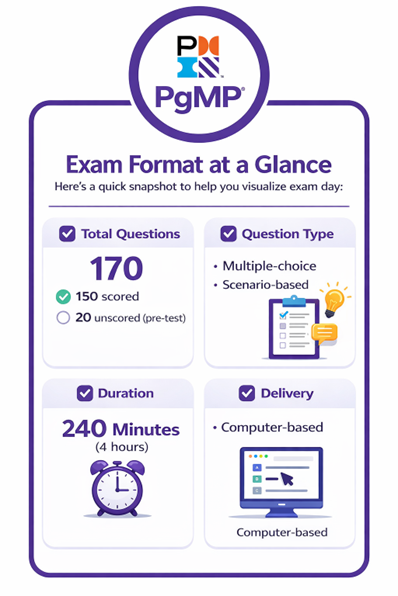
The PgMP certification exam is a 4-hour, computer-based test with 170 multiple-choice questions. Almost all questions are scenario-based, meaning you will be asked what a program manager should do next in real-world situations.
Out of the 170 questions, 20 are unscored pre-test questions used by PMI to validate future exams. You won’t know which ones they are, so every question deserves equal focus. Only 150 questions count toward your final score.
This means endurance and decision-making matter just as much as knowledge.
PgMP Exam Domains and Weightage
The PgMP exam is structured around five program management domains, each representing a key responsibility area of a program manager.
Domain Breakdown by Percentage
- Strategic Program Alignment – 15%
Focuses on aligning programs with organizational strategy and business objectives.
- Program Life Cycle Management – 44%
The largest and most important section. Covers planning, executing, monitoring, and closing programs.
- Benefits Management – 11%
Tests how well you identify, deliver, transition, and sustain program benefits.
- Stakeholder Engagement – 16%
Looks at communication, influence, conflict management, and stakeholder alignment.
- Governance – 14%
Covers oversight, decision-making structures, audits, and escalation paths.
Consider these domains as lenses through which PMI evaluates your judgment, not as isolated topics to memorize.
What Skills the PgMP Exam Actually Tests
The PgMP exam doesn’t reward mug-up learning. Instead, it evaluates how well you apply program management principles across the full lifecycle.
You will be tested on your ability to:
- Align programs with strategic goals
- Work effectively with sponsors and governance bodies
- Manage interdependencies across multiple projects
- Make trade-off decisions when benefits, risks, or timelines conflict
- Transition benefits smoothly into operations
In simple terms, the exam asks:
Can you think and act like a senior program leader in complex, real-world situations?
This is why preparation needs to be structured and why a month-by-month approach works so well.
Month 1: Build the Right PgMP Mindset (Foundation Phase)
Goal: Understand how PgMP thinking is different from PMP thinking.
Before opening question banks, spend time with the Standard for Program Management. This is the backbone of the PgMP exam.
A program is not a large project. It’s a group of related projects managed together to deliver strategic benefits. Your role is advisory and decision-oriented, not hands-on.
What to focus on this month:
- Read the Program Management Standard end-to-end (at least once) and invest in the PgMP certification Course.
- Understand program domains like Strategy Alignment, Benefits Management, and Governance
- Learn who does what: sponsor, steering committee, program manager, project manager
Consider it like this:
A project manager delivers the work; a program manager directs where the work should go.
Don’t rush into practice tests. Focus on clarity before speed.
Month 2: Deepen Knowledge & Connect the Dots
Goal: Move from understanding concepts to seeing how they work together.
This is where many candidates waste time reading everything repeatedly without linking ideas. PgMP questions test relationships, not isolated facts.
What to focus on:
- Read the standard again; this time, selectively
- Compare frameworks vs. life cycles vs. governance structures
- Understand program artifacts: roadmaps, benefit registers, governance plans
At this stage, flashcards help, especially for terms that sound similar but mean different things.
Example:
A benefit isn’t a deliverable. It’s the measurable value the organization gains after deliverables are in use.
Visualize a simple flow:
Strategy → Program → Projects → Deliverables → Benefits → Business Value
That mental picture helps during scenario-based questions.
Month 3: Practice with Purpose (Not Panic)
Goal: Apply PgMP logic consistently in exam-style scenarios.
Now is the right time to start full-length practice questions. Expect lower scores at first. That’s normal.
Most candidates score between 50%–60% initially, even with strong experience.
What to focus on:
- Practice questions that explain why an answer is right or wrong
- Identify weak areas (mostly Governance or Program Life Cycle)
- Revisit the standard to clarify confusion, not to reread everything
When reviewing answers, ask:
- Who owns this decision at the program level?
- Is this a strategic issue or a project execution issue?
- Does this require escalation or delegation?
This mindset shift is mostly the breakthrough moment.
Month 4: Refine Judgment & Exam Strategy
Goal: Think like PMI expects, not how things “usually work” at your job.
By now, content gaps should be shrinking. This month is about precision.
What to focus on:
- Scenario questions involving sponsors, steering committees, and trade-offs
- Eliminating “project manager reflex” answers
- Time management for a 4-hour, no-break exam.
Many successful candidates mark 20–30% of questions for review and revisit them calmly at the end.
Helpful habit:
Limit yourself to about one minute per question on the first pass. Trust your program judgment.
Final Weeks: Light Review, Strong Confidence
Goal: Reinforce, don’t overload.
In the last 1–2 weeks:
- Review summaries, flashcards, and weak domains
- Quickly review the most important sections of the standard (benefits, governance, roles)
- Avoid cramming new material
At this stage, consistency matters more than intensity.
You are not learning new concepts; you are validating how you already think.
Final Thoughts:
PgMP preparation isn’t about rushing through content. It’s about changing perspective. When you pace your study month by month, foundation first, then connections, then application, you reduce wasted effort and build real exam confidence.
If you choose to use a course, question bank, or study planner, treat it as a guide, not a shortcut. The real advantage comes from aligning your experience with PgMP logic. And once that alignment clicks, the exam becomes far less intimidating than most people expect.
 Charlotte